Saturday, May 30, 2020
Week 5: Ganja and Hess
The film this week is a perspective on the monstrous Other that I find intriguing because it's actively calling for sympathy for the characters, which I don't believe we've seen in this way thus far. Something that struck me about the Benshoff reading this week is what he says about media needing to appeal to a white dominated industry in order to find an audience: "the white main-
stream media shape public opinion about black cultural products." It makes me think about the role of the viewer, or the relationship between the viewer and the main characters in Ganja and Hess. Ganja and Hess are both monsters, but the film frames them as the protagonists of the story and encourages the viewer to sympathize with them. What interests me about sympathy in this case as opposed to previous films we've watched, like Texas Chainsaw Massacre, is that the film itself calls for it. Sympathy for Leatherface is existent and complicated, but far from equally as prioritized as the entertainment value from his violence and monstrousness. Ganja and Hess doesn't prioritize entertainment over sympathy for it's characters. There's something about a film calling for sympathy from the audience for the monstrous Other that prevents the "normal" viewer from being passively unsympathetic. Is white-mainstream media's sort of non-response to this film just for the comparative lack of action packed entertainment or a way to ignore that call for sympathy for the monstrous Other? Probably both, but I do want to understand more about the relationship between emotional appeal for a "normal" audience, or white-mainstream media, and sympathy for the Other.

Tuesday, May 26, 2020
Week 7: Creature from the Black Lagoon
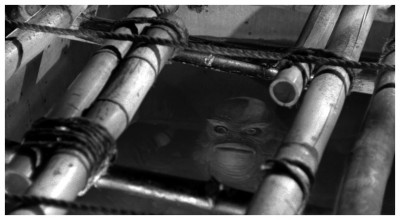
This is another film I hadn't seen before this week, and I watched it with my dad and my brother. We had a blast laughing at all the weird things like this shot above (my new favorite) and when the creature first sees the girl swimming, reaching toward her but flinching away as he is enamored by her beauty. After that he decides to snatch her away multiple times anyway. Despite any of that, the girl still looks toward the lagoon with a face that says "I've never felt this way about someone like him before". The sexual tension between the creature and the female protagonist reminds me of the relationship in The Shape of Water minus everything that made it endearing, and that's probably because Creature from the Black Lagoon isn't really about that. As Carol Clover touches on, it's about the men and their grappling with the irrational vs. the rational, or the white science vs. the black magic. Whatever's going between the creature and the girl serves to fulfill the male fantasy of saving the damsel from evil, or from the rival.
Monster aside, the rival scientist makes at least one comment toward the female protagonist. This rival is the main male protagonist's superior, and treats him with little respect when the male protagonist tries to be rational. The rival talks down to him in favor of pursuing the irrational, only thinking of what he can gain from the situation now, while the male protagonist stays rational and tries to focus on escaping and coming back better equipped. As far as saving the girl, it's as if she's being saved both from the monster trying to take her and her own attraction to the monster, like it's the male protagonist's duty to save her from being attracted to the wrong men. I got a bit of a nice guy vibe from male fantasy in this film.
Thursday, May 7, 2020
Week 1: Introduction
I'm reposting the week 1 introduction blog from moodle onto here so that they are all in the same place.
Hi I'm Sarabeth (she/they), and I'm a junior physics major and film minor. I'm stuck in my house in Robbinsdale, Minnesota, which is right next to Northeast Minneapolis. Quarantine is rough. The only things keeping me going are playing Magic: The Gathering with my brother and the all new Animal Crossing: New Horizons.
I'm taking this class because topic classes with Amy are great, and horror is my favorite film genre. I'm very excited to revisit some of my favorites on the syllabus and to see some new ones as well!
Hi I'm Sarabeth (she/they), and I'm a junior physics major and film minor. I'm stuck in my house in Robbinsdale, Minnesota, which is right next to Northeast Minneapolis. Quarantine is rough. The only things keeping me going are playing Magic: The Gathering with my brother and the all new Animal Crossing: New Horizons.
I'm taking this class because topic classes with Amy are great, and horror is my favorite film genre. I'm very excited to revisit some of my favorites on the syllabus and to see some new ones as well!
Week 4: The Untold Story
Like many teenagers, I used to seek out the goriest, grossest horror movies or clips that I could find. It was thrilling to see that kind of extreme violence, and I guess I got some rebellious satisfaction out of sharing them with my friends. Most of those were in the slasher genre, which is super formulaic. There are rules to follow, and you can anticipate the nasty things that happen. I enjoyed that kind of thing because it was predictable and it didn't cross this weird line that Untold Story absolutely obliterates. This film's extreme violence hit different, and I enjoyed almost none of it. We talked a lot about western taboos in this last week's class meeting, particularly with two scenes: the long, drawn out rape/murder scene, and the family massacre scene. We talked about the same question that opens Jack Valenti's statement: How much is too much? It's a really good question, since too much can harm people. There was a lot of concern about children's content on YouTube a couple years ago, since content farms were creating these really really bizarre, violent, and reportedly traumatizing videos for children. With Bonnie and Clyde, the concern is the glorification of violence. Will this glorification make an impressionable audience act more violently? I don't think depictions of terrible things make people do terrible things, but seeing "too much" does something to us. That's what this filmmaker is going for, right? These scenes that depict the taboo elicit a visceral reaction from the viewer. It's not the artist's responsibility to make the experience comfortable, so I begin to think that "too much" is purely subjective and that the individual decides what they should and shouldn't see. However, I think back to the concerns with YouTube and other general concerns with children's' exposure to pornography and violence on the internet. I find myself agreeing that it is way too easy for kids to find this content. When is it our responsibility to protect our society from taboo in art, and when do we leave it to the individual? How do we decide what's harmful?
Subscribe to:
Posts (Atom)
-
Barbara Creed discusses abjection in the mother-child relationship as the struggle for the child to break away from the mother. However, ...
-
Like many teenagers, I used to seek out the goriest, grossest horror movies or clips that I could find. It was thrilling to see that kind of...
-
The first time I saw Nosferatu was Halloween of 2009, when my brothers and I all got the swine flu and couldn't go trick-or-treatin...

